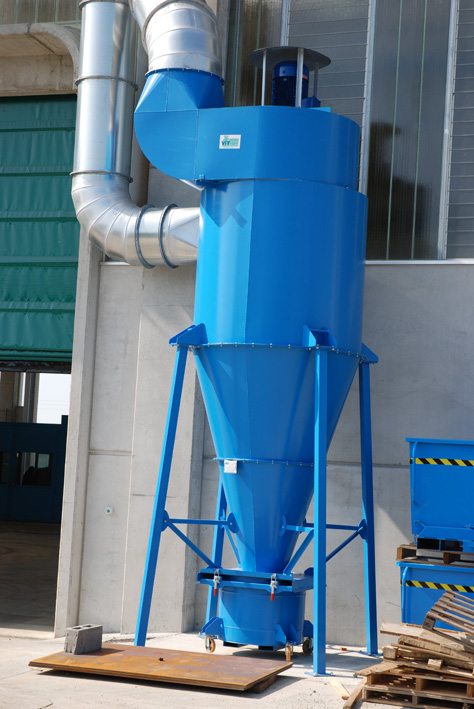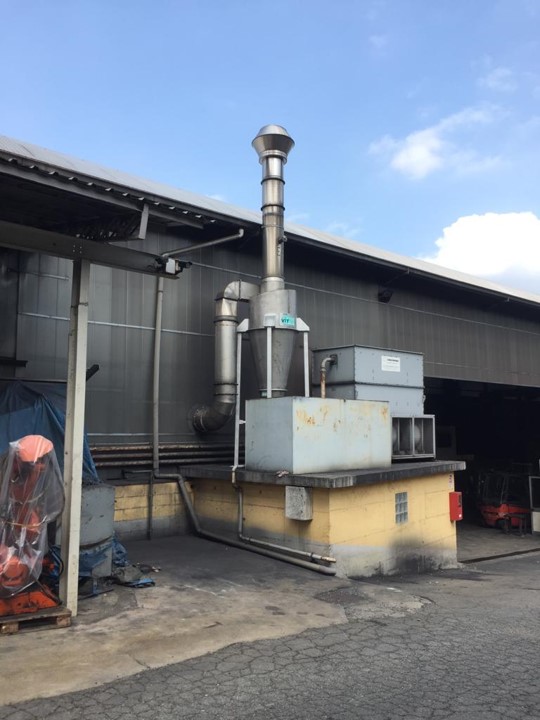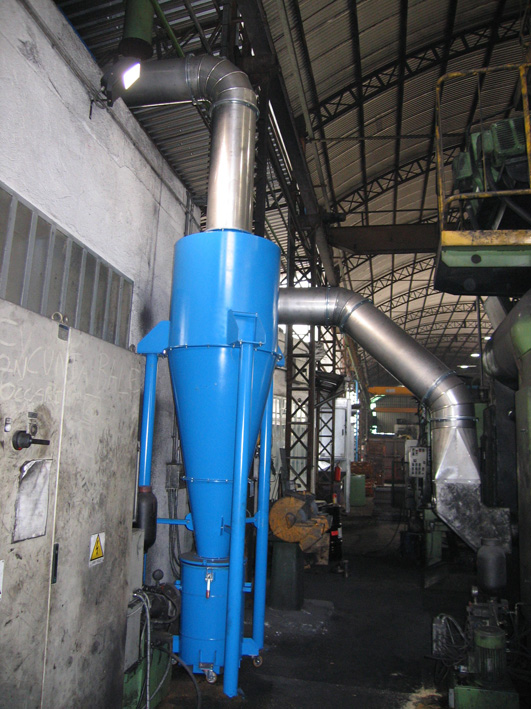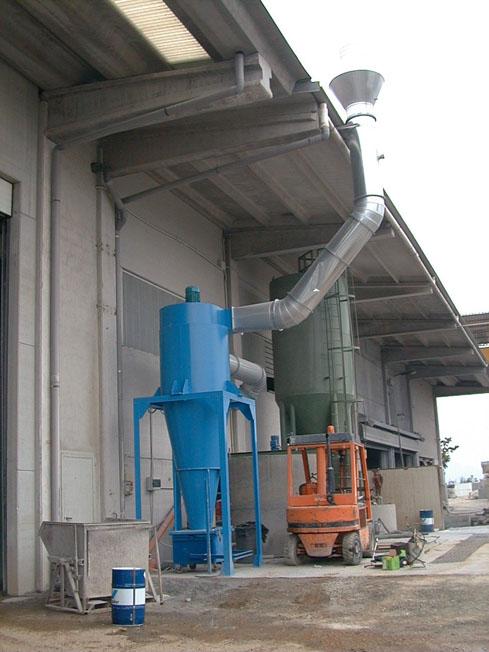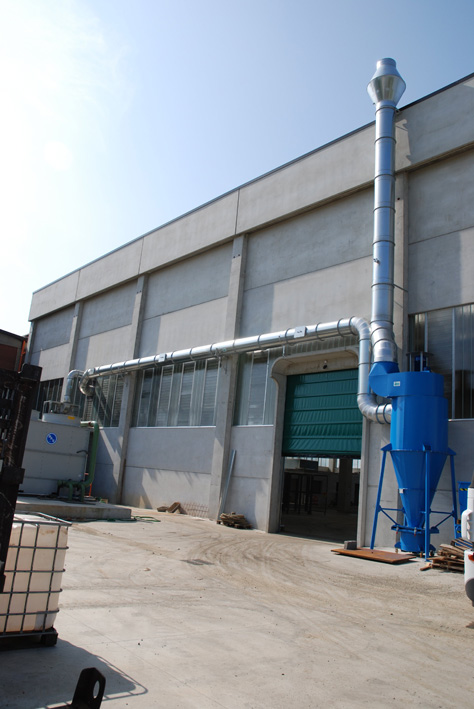
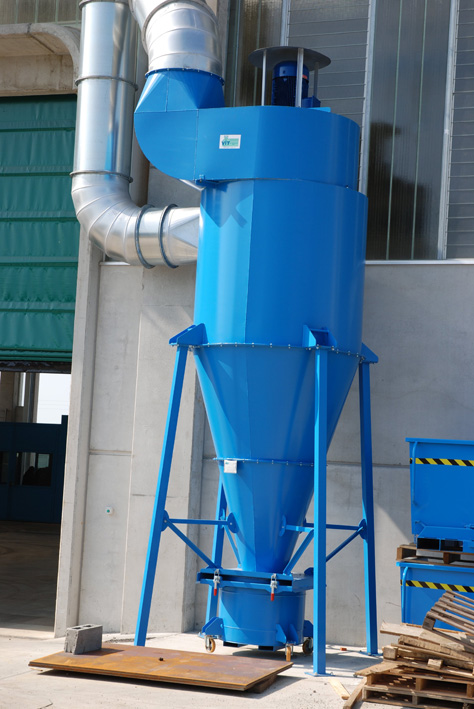
The SPC Series is a range of cyclone dust collectors designed for the abatement of dust generated by woodworking processes and other industrial applications, particularly when particle size is greater than 30 microns. It is a reliable and robust solution, developed to ensure consistent performance and simple operation.
Industrial cyclones in the SPC Series are custom-built to match the specific requirements of each system and the characteristics of the dust to be treated. The cyclonic separation principle captures coarser particles by exploiting centrifugal force, without the use of traditional filter elements, thereby reducing maintenance requirements.
Filtration efficiency, typically ranging between 85% and 90%, is directly related to the particle size and specific weight of the dust: the larger and heavier the particles, the higher the system’s efficiency. This makes the SPC Series particularly suitable for production environments where dust is not extremely fine but must be removed continuously and reliably.
Ideal for: rubber processing, mechanical and metalworking operations, forklift battery charging areas, and industrial painting applications.
The Cyclone dust collector filter is suitable for woodworking and spray painting applications where it is necessary to contain dust. The configuration can be adapted to a single workstation or integrated into an existing extraction system, helping to keep the working air more stable and controlled.
The Cyclone dust collector filter is designed to capture dust through a modular cyclonic filtration system (up to 90% efficiency), with selected filter components to ensure operational continuity. The possible presence of multiple filtration stages is defined based on the particle size and concentration of the contaminants.
For the Cyclone dust collector filter, sizing depends on capture distance, intake geometry, and system pressure losses. When available, the indicative range corresponds to the airflow required at the capture point; in any case, it is recommended to verify the data based on the actual emission point and operating conditions.
The Cyclone dust collector filter requires periodic checks of seals and structural components, as well as inspection and maintenance of any downstream filtration stages according to the workload. In systems combined with secondary filters, it is useful to monitor pressure drop and plan maintenance before performance decreases.
To properly integrate the Cyclone dust collector filter, attention must be paid to positioning relative to the source, sealing of connections, and accessibility for inspection and maintenance. It is also important to verify compatibility with company safety procedures and with the characteristics of the treated dust.