Articulated suction arms for localised collection of polluted air, fumes and dust, available in several sizes to adapt to different industrial applications.
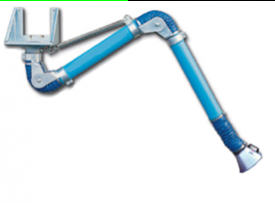
The suction arms are collection elements designed to intervene directly at the source of emission of the pollutant in the work areas, allowing to collect fumes, vapours, dust or mists before they are dispersed into the environment. The articulated structure allows you to easily orient the arm in the desired position, thanks to robust and balanced pivot points that facilitate movement during production processes.
Available in different standard sizes (e.g. Ø180 × 3,300 mm or Ø180 × 4,200 mm), these arms can be integrated into centralised suction or connected to filters or trolleys, depending on the needs of the production process.
Their versatility makes them suitable for multiple industrial applications where precise control of airborne pollutants is required, improving air quality, operator safety and overall system efficiency.
New suction arms are suitable for industrial processes where it is necessary to contain dust, fumes, oily mists, and vapors. The configuration can be adapted to a single workstation or integrated into an existing extraction system, helping to keep the working air more stable and controlled.
New suction arms are designed to capture dust, fumes, oily mists, and vapors through a modular filtration system, with filtering elements selected to ensure operational continuity. The possible presence of multiple stages is defined based on particle size and contaminant concentration.
For new suction arms, sizing depends on capture distance, inlet geometry, and system pressure losses. When available, the indicative range is the airflow required at the capture point; in any case, it is recommended to verify the data based on the actual emission point and operating conditions.
New suction arms require periodic checks of filters, gaskets, and seals, as well as cleaning or replacement of the filtering elements according to the workload. In versions with self-cleaning systems, it is useful to monitor differential pressure and schedule maintenance before performance decreases.
To properly integrate new suction arms, attention should be given to positioning relative to the source, sealing of connections, and accessibility for inspection and maintenance. It is also important to verify compatibility with company safety procedures and the characteristics of the treated contaminant.