
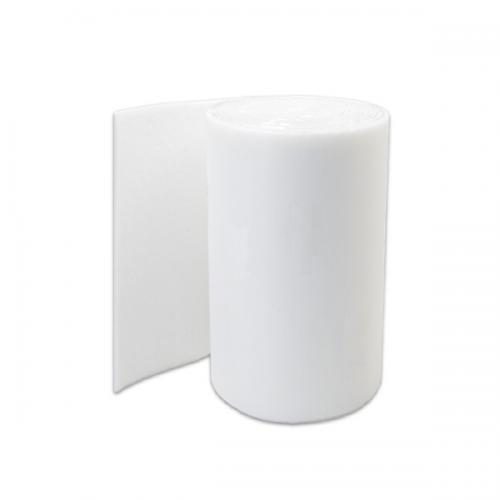
The Synthetic filter mat is suitable for spray painting applications where it is necessary to contain dust. Its configuration can be adapted to a single workstation or integrated into an existing extraction system, helping to maintain a more stable and controlled working air environment.
The Synthetic filter mat is designed to capture dust through a modular filtration system, with filter elements selected to ensure continuous operation. Multiple filtration stages may be used depending on particle size and contaminant concentration.
For the Synthetic filter mat, proper sizing depends on capture distance, intake geometry, and system pressure losses. When available, the indicative range corresponds to the airflow required at the capture point; in any case, it is recommended to verify data at the actual emission source and under operating conditions.
The Synthetic filter mat requires periodic checks of filters, gaskets, and seals, as well as cleaning or replacing filter elements based on workload. For versions with self-cleaning, it is useful to monitor differential pressure and schedule maintenance before performance decreases.
To properly integrate the Synthetic filter mat, attention should be paid to positioning relative to the source, sealing connections, and providing access for inspection and maintenance. It is also important to ensure compatibility with company safety procedures and the characteristics of the contaminants being treated.